Germany's election is a dangerous preview of where anti-Muslim rhetoric leads.
Germany's election is a dangerous preview of where anti-Muslim rhetoric leads. America is next in line.
The Alternative für Deutschland won its first German state on Sunday. In Saxony-Anhalt it took 43.8 per cent on a record 77.8 per cent turnout, its best result in any German state election. This is a party whose manifesto holds that Islam is not compatible with the German constitution. It finished three seats short of governing outright, in a country that once watched the Nazi party enter the Reichstag on 2.6 per cent of the vote and talk its way into power within five years.
On Wednesday, German Chancellor Friedrich Merz told parliament that the AfD's remigration policy amounts to "ethnic cleansing" by skin colour and origin.
He is two decades late.
The AfD did not get this powerful overnight. In 2010 the Social Democrat Thilo Sarrazin published a book arguing that Muslim immigration was making Germany poorer and less intelligent; it sold 1.5 million copies. In 2018, Merkel's own interior minister announced that Islam does not belong to Germany. And it is not that Germans said nothing. When journalists exposed a meeting where party figures discussed deporting millions of people, including German citizens, some 3.5 million filled the streets in the largest protest wave of the postwar era. The AfD's vote rose anyway.
And Germany is not alone. Across Europe, 23 per cent of voters now choose the far right, against 5 per cent in 1995. Britain has watched its own version up close: Reform UK won 2 per cent of the vote in 2019 and 14 per cent in 2024, and now polls level with Labour for government.

I have spent 25 years in the rooms where American policy on Muslims gets written, and I can see the same road opening in front of us.
The first sign is the rhetoric, and how little it costs.
In December, President Donald Trump called Somali immigrants "garbage" at a televised cabinet meeting. In August, days after Abdul El-Sayed won Michigan's Senate primary, he posted a graphic pairing himself and the first lady with El-Sayed and his hijab-wearing wife, captioned "Two VERY DIFFERENT America's". Senator Tommy Tuberville, who won the nomination for governor of Alabama in May and is the favourite in November, posted images of September 11th beside New York's Muslim mayor and calls him the enemy inside the gates. Congress now has a Sharia-Free America Caucus. Democrats have introduced censure resolutions. None have passed.
Consider what that licenses outside politics. In March 2002, six months after the towers fell, 25 per cent of Americans told Pew that Islam encourages violence more than other faiths. This January it was 51 per cent. None of this stays contained. In May, two teenagers with a manifesto citing Christchurch shot three men dead outside the Islamic Center of San Diego. The Council on American-Islamic Relations logged 8,683 complaints of discrimination last year, its highest since it began counting in 1996.
Meanwhile, xenophobic policy continues to pass. A travel ban first written for seven Muslim-majority nations has been rewritten twice since, and now covers 39 countries. Congress has given ICE roughly $45 billion for detention and 10,000 new officers, and an internal memo targets 92,600 beds. Remigration, the AfD's own word for mass deportation, is now an office inside the State Department. Detention hit a record 73,000 people in January, up more than 75 per cent in a year. The Justice Department has filed 123 complaints seeking to revoke citizenship since January 2025 — by its own account the most in recorded history — and internal guidance now asks field offices for 100 to 200 referrals every month.
Germany's firewall did not fall on Sunday. It was dismantled over twenty years. In America, we already have the budget, the beds, the offices and the monthly quotas — and an argument the AfD would recognise coming from a sitting president. So the question is not whether this government could turn those tools on its own citizens. It plainly could. It is whether we will permit it.
We still have time. In November, Americans vote, ultimately answering the question – what country do we want to be?
If America will not confront its own rhetoric crisis, it will herald its own AfD.

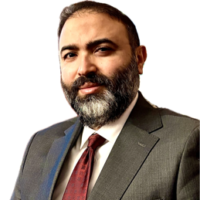
Salam Al-Marayati is president and co-founder of the Muslim Public Affairs Council (MPAC), where he leads the organization’s civic engagement, public policy, and advocacy efforts. Nationally recognized for his work to strengthen public understanding of Islam and advance policies affecting American Muslims, he has spent decades engaging policymakers, community leaders, and the public on issues of religion, democracy, and civil rights.