Tech and Trump
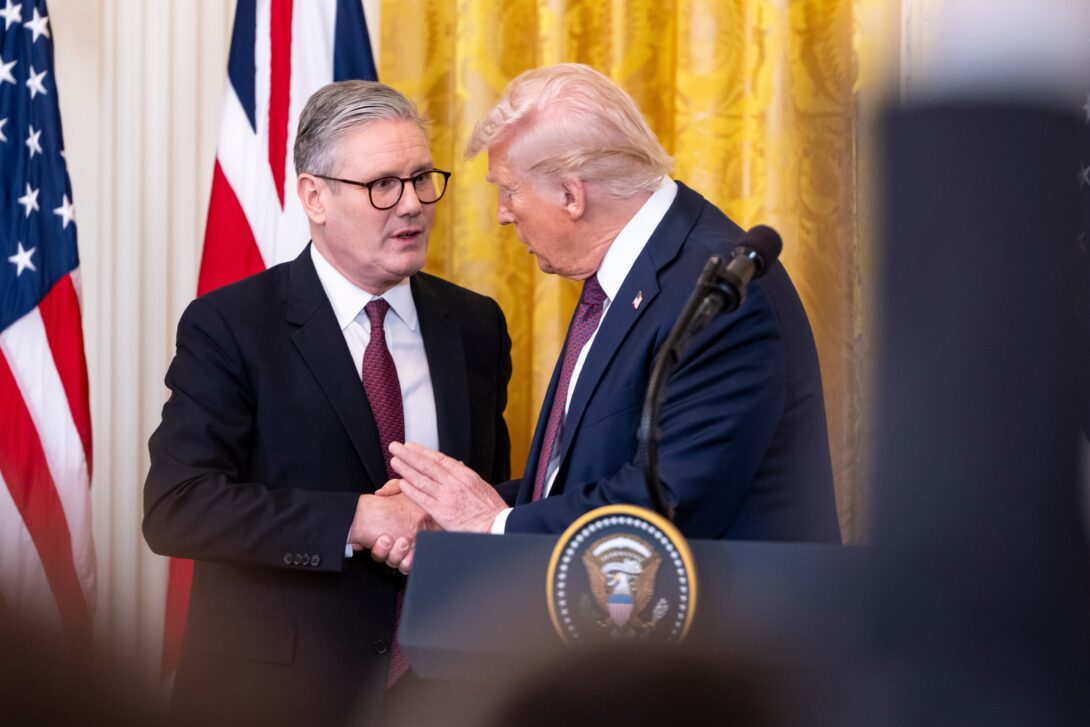
The British government has been scrambling to keep up with the outrageous behaviour of the rogue superstate which happens to be our main ally and with which we claim to have a ‘special relationship’. Keir Starmer says that he had no warning of the attack on Venezuela which suggests that he has clean hands but no influence.
A subject much closer to Britain’s long term vital interests are forthcoming negotiations with the Trump Administration on technology. These talks will determine whether Britain is to be a digital and AI colony or retains some vestiges of sovereignty.
They affect our freedom to levy taxes. They affect our freedom to manage the flow of sewage contained in social media content being defended as ‘free speech’. They complicate any move to realign regulations with the EU.
Furthermore, the allegiance of the leading tech companies to the Trump Administration makes any commercial deal highly political. And geo-political too since we are being pressed to choose between the two superpowers.
The pending negotiations build on the Economic Prosperity Deal under which the USA agreed to reduce Trump’s ‘Liberation Day’ tariffs to the baseline 10% (rather than the EU’s 15%) in return for various UK concessions. One concession was accepting a ‘poison pill’ limiting agreements with ‘non-market’ economies (i.e. China).

The next stage is a Technology Prosperity Deal which promises more digital infrastructure investment in the UK in return for more UK concessions on policy. The USA objects to the UK 2% digital sales tax and to the UK On-line Safety Act which is said unfairly to constrain US AI companies. Other irritants have included British demands under the Investigatory Powers Act, for Apple to break its end-to-end encryption.
Britain has a high dependence on US tech companies. Britain’s digital economy accounts for around 13% of GDP (manufacturing is around 9%). The digital economy in turn depends largely on the platforms and services of US tech companies. The new growth area is AI where US companies also dominate.
Dependence stems from the power of the algorithms used by the tech companies which can be manipulated to slant output to serve the interests of owners or the ideological prejudices of the Trump administration. The opaque decision-making processes of AI make subtle manipulation easier. The sheer complexity of AI also makes it easier to lock users into platforms which then become embedded and difficult to replace.
In principle, users have the option of using competitive alternatives which, in practice, are Chinese: platforms like Alibaba or Deep Seek for AI. But Chinese companies have difficulty meeting privacy regulations; and there are security and geo-political concerns. In any event the UK has already conceded to the USA an effective veto over Chinese involvement.
Attempts to reduce dependence and exercise digital sovereignty not only risk the loss of critical services but can incur the wrath of the Trump Administration. The Administration has extra-territorial powers like the Cloud Act (which can force the disclosure of foreign data). Or retaliation could involve the use of tariffs.
Nonetheless, customers countries have some agency in regulating access to their markets. Indeed, the EU is seeking not only to exert technological sovereignty but to set global standards. The EU’s declared objective is to keep all EU data in Europe under European regulation and subject to storage and processing by European countries. The first step along this road was EU’s General Data Protection Regulation which set tough new standards for protecting personal data. A proposed Data Act protects consumers’ non-personal data. This ambition directly conflicts with the aims of the United States’ Cloud Act.
Other disputes arise from the EU’s Digital Services Act which establishes rules for digital intermediaries on content and transparency and which seeks to curb disinformation. An investigation into X regarding transparency resulted in a modest – 120 million Euro – fine. But it outraged the White House. Other tech companies face investigations under the Act over and above investigations, and fines, from competition authorities.
The EU is a major market but has a critical weakness. Insistence on ‘buying European’ lacks credibility when the EU has failed to produce its own tech platforms and has few indigenous AI companies. Europe has ‘lost the Internet’ said one critic. Attempts to exclude investment by US companies would now diminish European capacity further.
Post-Brexit Britain has less leverage as a smaller market but the supposed advantage of being less disliked by Trump than the EU. But both are weakened by dependence on the USA for defence, including support for Ukraine. In the case of the UK, the USA is using carrots rather than sticks in the form of vague promises of large-scale investment in AI infrastructure. (though Britain is already an attractive and growing AI market and new investment, notably by Microsoft, is happening anyway).
But Britain has two red lines which must be defended. One is Britain’s commitment to a 2% digital sales tax: this at a time when many ‘bricks and mortar’ businesses are failing in part because of tax burdens which digital companies do not face. The second is Britain’s right to stem the flow of unsafe, toxic and politically invasive content which the US companies and Administration sometimes equate with ‘free speech’. Failure to defend Britain’s digital sovereignty on these key issues will show us as being little more than a vassal state.

Sir John Vincent Cable is a British politician who led the Liberal Democrats from 2017 to 2019 and represented Twickenham in Parliament from 1997 to 2015 and again from 2017 to 2019. He served as Secretary of State for Business, Innovation and Skills and President of the Board of Trade in the coalition government between 2010 and 2015. Cable studied natural science and economics at Cambridge before working as a finance officer in the Kenya Treasury and lecturing in economics at Glasgow University, where he also earned his PhD. His distinguished career included roles in the Diplomatic Service, directing research at the ODI, advising the Commonwealth Secretary-General, heading the international economics programme at Chatham House, and serving as Chief Economist for Shell Group Planning.

Most Popular




More from Technology