The future of the UK’s sustainable fusion energy
Fusion energy is often called the ultimate energy source. Based on the same physical processes that power the sun and stars, it has the potential to be revolutionary.
Fusion energy is extremely fuel-efficient, creating millions of times more energy, per kilogram, than burning fossil fuels - and far more so than nuclear fission.
Fusion can be thought of as the opposite of fission – combining lighter atoms rather than splitting heavier ones to produce a plasma, a dense ‘soup’ of charged particles with positively charged ions and free electrons, which can fuse together and release energy.
There are many ways to achieve fusion, but all require heat or pressure. Each approach is extremely challenging as at the heart of any fusion system is a burning plasma.
To make fusion happen, a gas of hydrogen fuel must be heated to extreme temperatures (typically over 100M degrees Celsius) – and keeping a plasma well confined and stable enough to sustain fusion is hard. If the plasma cools, fusion will instantly cease. This also happens to be one reason why fusion is a safe and low risk technology.
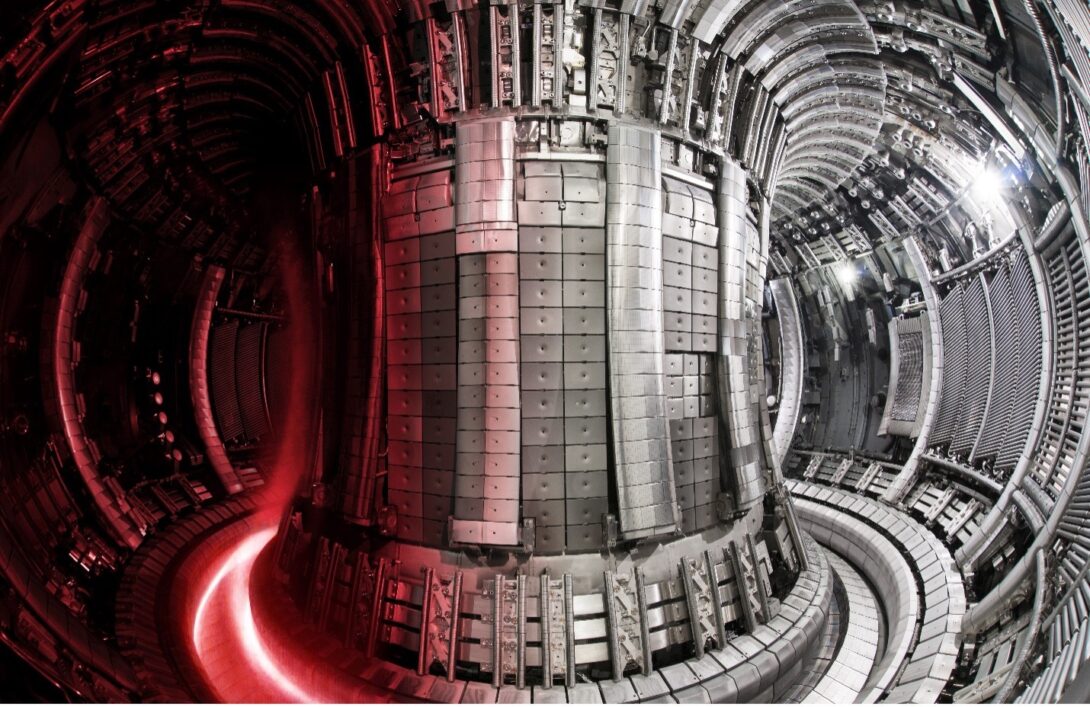
The most advanced way of making and confining this plasma is in machines called tokamaks – where powerful magnetic fields are used to hold the plasma in a ring-shaped container.
In the UK, fusion has been proved to work in large laboratory experiments, such as the Joint European Torus (JET) and MAST-Upgrade facilities on the United Kingdom Atomic Energy’s Culham Campus in Oxfordshire. Several milestones using these machines have been achieved by the fusion community over the past few years.
In February 2024, JET announced it could produce 69MJ of fusion energy at high power. Whilst the fusion reaction was sustained only for five seconds due to limits posed by the older technology installed at JET, it has instilled greater confidence in the development of fusion energy. To put the number into perspective, this is roughly equivalent to powering 12,000 homes for that duration using only 0.2mg of fuel – the same weight as a fruit fly.
Fusion plasmas can now be reliably created using the same fuel mixture to be used by commercial fusion energy powerplants, showcasing the advanced expertise developed over time.

Building on the know-how developed with JET, the MAST-Upgrade facility will soon demonstrate the effectiveness of a smaller exhaust system, a key element in the development of any future fusion power plant. The effectiveness of this exhaust system will allow components in future commercial tokamaks to last longer and bring costs down.
The experiments conducted on these machines all pave the way for the potential commercialisation of future machines.
The UK is pursuing its first prototype fusion powerplant, called STEP, in West Burton, Nottinghamshire. The aim of this prototype is to produce net positive electricity for the grid in the 2040s. STEP is a few decades away, but what about now?
Although fusion power promises to be an important and sustainable part of the world’s energy supply in the second half of this century, we will reap its benefits well before. The near-term benefits of fusion have already been demonstrated.
Obliged to innovate in response to extreme conditions and harnessing the power of the atom, the fusion industry has catalysed numerous technological breakthroughs that have been successfully transferred to adjacent sectors, such as healthcare, marine, aeronautical, and space industries.
A few notable examples include the use of advanced robotics in disaster relief and space exploration, super magnets in marine propulsion, modelling tools and precision manufacturing techniques that enhance quantum computing, the application of gamma spectroscopy imaging in cancer therapy, and the creation of a diamond battery, which is able to provide a stable low-power source for thousands of years.
The spillover benefits from fusion extend beyond individual industries, contributing to broader economic growth.
Fusion research drives advancements in cutting-edge technologies, fostering the development of highly skilled jobs and boosting local and global competitiveness. By improving productivity and opening new markets, it generates progress in fields critical to improving human health, safety, and technological capability.
If current forecasts are correct, fusion could meet 10% of global energy demand by 2100 – equivalent to supplying all of Europe – or as much as 40% if capital costs were 30% cheaper. Long may the quest for fusion energy continue.

Celestine Cheong is Head of External Communications at the Atomic Energy Authority