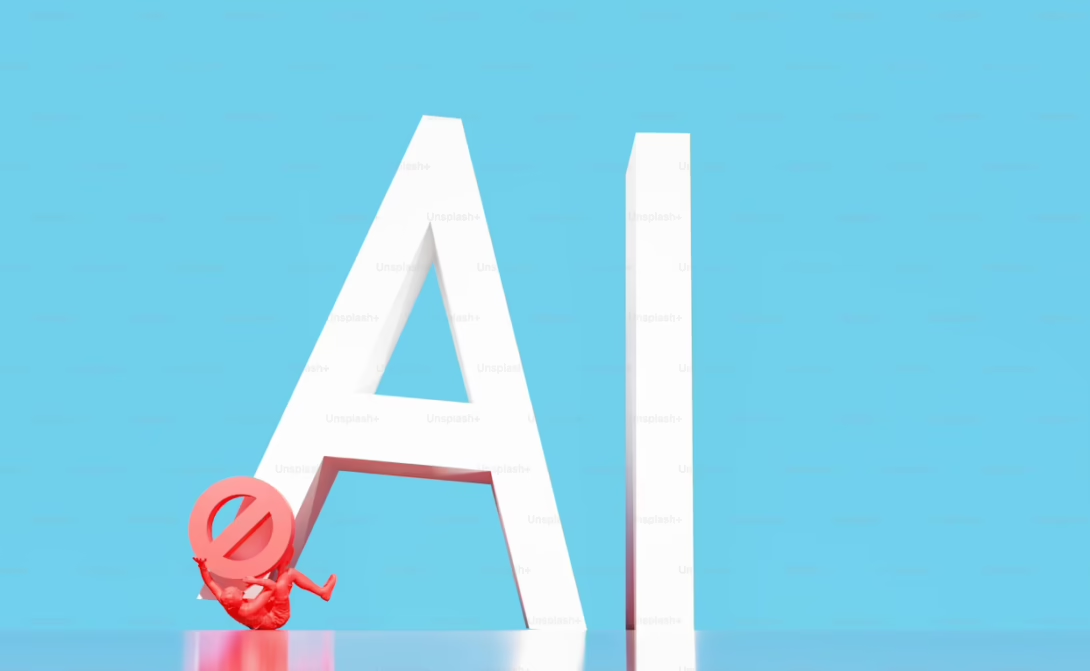
AI: existential threat or unprecedented productivity boost?
Artificial Intelligence (AI) is changing the way we work at an unprecedented speed. By 2030, nearly 1.1 billion jobs could be reshaped, those were words of Lisa Stevens’ during Davos, World Economic Forum 2026. There is growing concern that generative AI could significantly undermine the white-collar workforce. Many fear that in major cities such as London, and across other developed economies, large numbers of professionals will become unemployed as their roles are replaced by automation. These concerns were also amplified when Ford CEO Jim Farley warned in October 2025 that generative AI could “replace literally half of all white-collar workers.” But is generative AI truly this detrimental to the white-collar industry, or is this dystopian outlook exaggerated? Could AI rather make us all more efficient, “empowering workers to be more productive,” rather than obsolete?
A new study
conducted by Dr Bouke Klein Teese link at King’s College London sheds important light on this debate. Analysing millions of job postings and LinkedIn profiles between 2021 and 2025, the study found that the public release of ChatGPT in November 2022 marked a clear turning point. Its impact, however, varied significantly depending on how susceptible different roles were to automation by large language models (LLMs). Firms with workforces highly exposed to AI capabilities reduced total employment by an average of 4.5 per cent. Crucially, this reduction was concentrated almost entirely in junior roles, which fell by 5.8 per cent.
This finding aligns closely with my own research at King’s College London, where I am examining how large language models such as ChatGPT are being used in the PR and communications industry. Through interviews with senior associates across a range of strategic communications agencies, from global firms to smaller public affairs consultancies, a clear consensus emerged.

Senior partners described in my research that tasks traditionally assigned to junior associate, the so-called “grunt work”, can now be performed entirely by generative AI. In practice, senior professionals are increasingly using AI tools to complete work they would previously have delegated. However, there was also broad agreement that generative AI will not replace the communications industry altogether. Instead, it will fundamentally reshape it, requiring PR professionals to develop new skill sets. In 1913 when Henry Ford automated manufacturing, he didn’t then go onto make 50% of manual jobs redundant. I today, do not believe the technology revolution that is generative AI will replace half of today’s white-collar jobs.
Importantly, while my research confirms that Senior Partners are increasingly using AI in place of junior associates, this practice is not necessarily encouraged throughout industry. Junior staff still need to undertake foundational tasks to understand how the industry operates. However, Junior staff will not be able to understand how the industry operates if they rely on generative AI as a tool for the fundamental skills needed for a strategic communications profession which include research, content generation, analysis, drafting reports and writing emails. The demand for communications work remains, and junior associates must still be trained to perform these roles in order to progress professionally, this progress could be undermined by Senior Partners neglecting working with junior associates as they are just turning to generative AI, this could be a major threat to today’s new recruits.
Generative AI continues to have significant limitations. It relies on existing information and excels as a research and drafting tool, but it lacks the human creativity and innovation required to generate genuinely new ideas. One communications professional described their workflow using a “20–60–20 rule”: the first 20 per cent of a task is completed by a human, the middle 60 per cent by generative AI, and the final 20 per cent again by a human. This final human review is essential. At present, communications tasks cannot be completed by AI alone; instead, AI serves to make work more efficient.
While it is true that generative AI has already reduced employment in parts of the white-collar sector, another research participant argued that AI is unlikely to undermine employment entirely. Rather, it will act as a disruptor, reshaping roles and skill requirements instead of eliminating jobs outright.
A further point of strong consensus was that generative AI cannot replace human interaction or networking. Participants repeatedly emphasised that for strategic communications firms to remain successful, they must ask a fundamental question: what can humans provide that AI cannot? And what more can we humans achieve by standing on the shoulders of AI?
Ultimately, only time will tell how generative AI will shape the white-collar industry. What is clear is that the nature of white-collar work is changing. The debate continues over whether generative AI will replace jobs or enhance efficiency. For some companies, AI is already proving transformative. At London-based law firm A&O Shearman, for example, generative AI has effectively multiplied the firm’s workforce, enabling it to take on projects it would previously have declined, according to partner and global head of AI, David Wakeling.
If generative AI can satisfactory complete 60% today of administrative or drafting tasks, and as Demis Hassabis describes “the pace of AI’s ability to take on human job skills as exponential, fast-accelerating, and likely to outstrip society’s ability to adapt’, then our political leaders must provide leadership, to enable the UK to realise the productivity gains, without having to sacrifice our society.

Jacob Solon is a research-focused communications professional with experience across public affairs, political analysis, and strategic communications.





More from Technology